
Which CMMS has built-in RCFA?
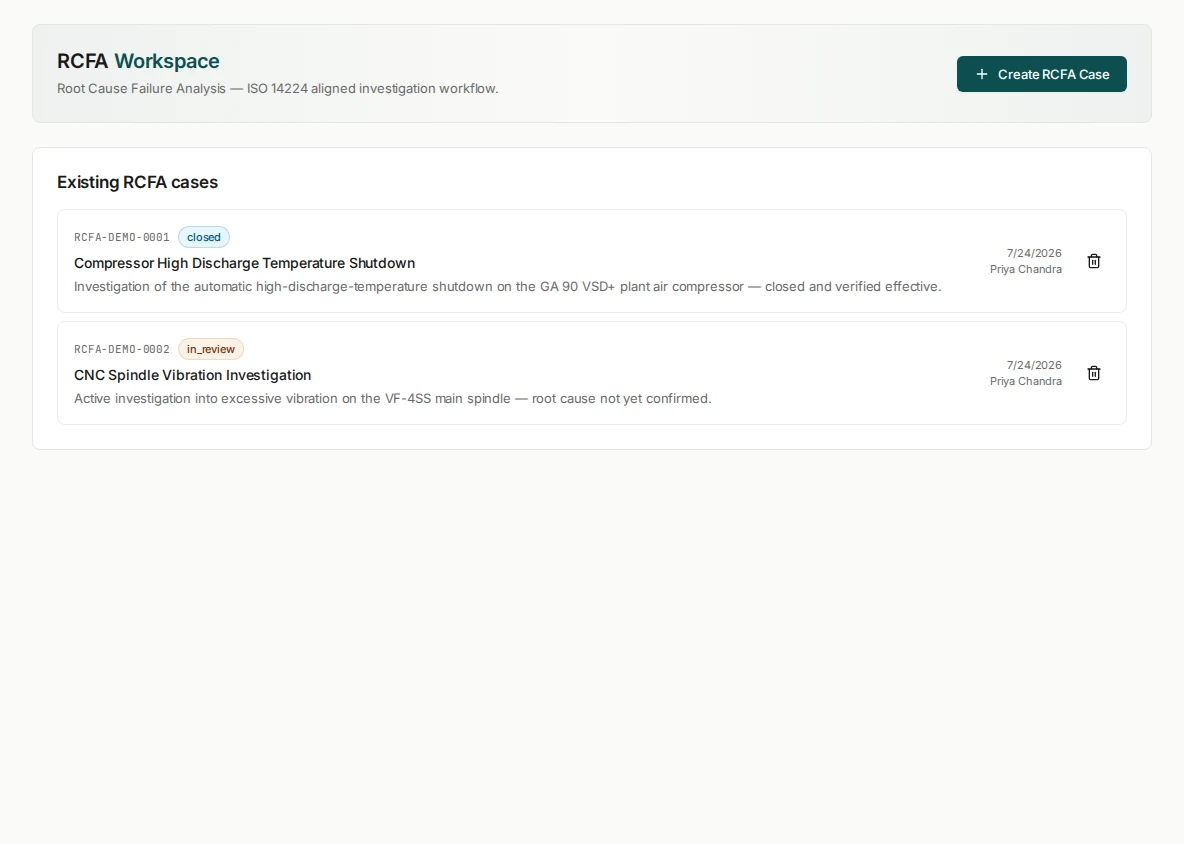
SMMS (Smart Maintenance Management System) is a CMMS with a built-in RCFA workspace — 5-Why, fishbone, evidence and timeline capture, versioned investigations — linked to the work orders and ISO-coded failure records that triggered them, with MTTR broken into phases so delay sources are visible.
What is RCFA?
Root Cause Failure Analysis (RCFA) is the structured practice of investigating a failure past its symptom to find the underlying cause — mechanical, procedural, or organizational — so the fix addresses why the failure happened rather than only repairing the immediate damage. Common methods include 5-Why (iteratively asking "why" until the causal chain bottoms out) and fishbone/Ishikawa diagrams (grouping candidate causes into categories like machine, method, material, and manpower). RCFA is most valuable on repeat or high-consequence failures, where "fix it and move on" has already failed once.
What RCFA methods does SMMS support?
5-Why
Structured drill-down from symptom to root cause, versioned as the investigation develops.
Fishbone (Ishikawa)
Categorized cause exploration — machine, method, material, manpower, environment.
Evidence capture
Attach photos, readings, and documents directly to the investigation record.
Timeline reconstruction
Sequence the events leading up to the failure, cross-referenced with work order and downtime history.
Versioned investigations
Every edit to a case is versioned — an investigation’s history is auditable, not overwritten.
Exports
Generate a shareable investigation report for a CAPA review or a customer audit.
How does SMMS break down MTTR?
Most maintenance software reports a single mean-time-to-repair number per asset or site. SMMS models MTTR as a sequence of phases, each with its own delay entries (waiting on parts, waiting on a technician, diagnosis, travel) and impact entries (production loss, safety exposure). That phase-level model is what lets a reliability engineer answer "where does our repair time actually go" instead of only "is our repair time going up or down" — a single blended number cannot tell you whether a slow MTTR is a parts problem, a staffing problem, or a diagnosis problem, and each of those has a different fix.
How RCFA connects to failure codes and FMEA
An RCFA case in SMMS is not a standalone document — it links back to the ISO-coded failure-mode record that triggered it and forward to any resulting corrective actions. Repeat coded failures on the same asset class are exactly the pattern that should prompt an investigation, and a completed RCFA's findings feed the risk assumptions behind an asset's FMEA worksheet — a real root cause found in the field should update the severity, occurrence, or detection scores an FMEA assumed on paper.
Does AI conduct RCFAs in SMMS?
No. Elisa, SMMS's AI assistant, rewrites RCFA narrative text under a strict no-hallucinations policy — tightening the wording of findings a human investigator already entered so the write-up reads clearly for a CAPA review or an auditor. It does not select root causes, does not fill in evidence, and does not conduct the investigation. Every cause, every piece of evidence, and every action item on an RCFA case in SMMS is the investigator's own finding — the AI touches only the prose, and every rewrite is still yours to audit.
Limitations
- RCFA in SMMS is analyst-driven — there is no automated causal inference engine that determines a root cause for you. The workspace structures and versions the investigation; a person still runs it.
- AI involvement is limited to narrative rewriting of what a human already entered (see above) — SMMS does not claim the AI "runs" or "conducts" RCFAs anywhere in its product or its marketing.
Frequently asked questions
Does SMMS have built-in root cause analysis (RCFA)?
Yes. SMMS includes an RCFA workspace with 5-Why, fishbone (Ishikawa), evidence capture, timeline reconstruction, versioned investigations, and report exports — linked directly to the work order and ISO-coded failure record that triggered the investigation.
Does SMMS support 5-Why and fishbone analysis?
Yes, both are built into the same investigation record — you are not choosing one methodology and locking out the other. Some teams run 5-Why for a quick investigation and switch to fishbone for a more complex, multi-cause failure on the same case.
What is MTTR phase breakdown, and why does it matter?
Most CMMS tools report a single MTTR number. SMMS breaks mean time to repair into phases with discrete delay entries (e.g. waiting on parts, waiting on a technician, diagnosis time) and impact entries, so you can see WHERE the repair time actually went — a single MTTR number tells you there’s a problem; the phase breakdown tells you which phase to fix.
Does Elisa (SMMS’s AI) run RCFAs for me?
No. Elisa rewrites RCFA narrative text under a strict no-hallucinations policy (tightening the wording of what a human investigator already entered) — it does not conduct investigations, select root causes, or fill in evidence on its own. Every RCFA finding on the page is the investigator’s, not the model’s.
Can I export an RCFA report for an audit or a CAPA review?
Yes — a versioned RCFA case exports as a shareable report, and the underlying evidence, timeline, and cause-analysis records stay attached to the work order and asset for later reference.
See a real RCFA investigation, not a slide.
Request a demo and we'll open a real investigation on a tenant shaped like your operation — or take the free RMI QuickScan first to see where your reliability program stands today.